
Pre-Execution Governance for AI Sandboxes: TealTiger + Daytona

How combining TealTiger's deterministic logic governance with Daytona's infrastructure isolation creates true defense-in-depth for AI agent code execution.
Pre-Execution Governance for AI Sandboxes: TealTiger + Daytona
Daytona gives your AI agents a safe place to run code — isolated kernel, ephemeral filesystem, controlled network. But isolation answers a different question than governance. Isolation decides where and how code runs. Governance decides if it should run at all.
This post covers the pattern we built to combine both: TealTiger scans LLM-generated code for secrets, PII, and policy violations before Daytona ever creates a sandbox. The result is defense-in-depth that no single layer can provide alone.
The gap: isolation without inspection
Consider what happens when an LLM generates code containing a hardcoded API key. In a sandbox-only workflow:
- The agent produces code with
sk-proj-ABC123...embedded in a string - The sandbox executes it in an isolated environment
- The key ends up in sandbox logs, process memory, or network traffic
The sandbox prevented the code from escaping. But it didn’t prevent the secret from entering. For compliance frameworks (SOC 2, HIPAA, EU AI Act), organizations need evidence that governance evaluated code before execution — not just that execution was contained.
Architecture: logic governance + infrastructure isolation
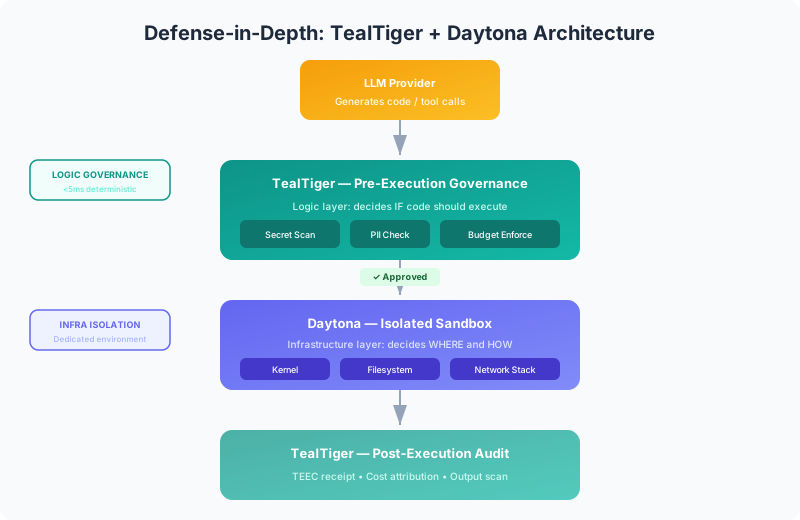
The integration creates a three-phase pipeline:
| Phase | Owner | Responsibility |
|---|---|---|
| Pre-execution | TealTiger | Scan for secrets (500+ patterns), PII, policy violations, budget check |
| Execution | Daytona | Isolated runtime: dedicated kernel, filesystem, network, resource limits |
| Post-execution | TealTiger | Audit receipt generation, cost attribution, output scan |
TealTiger operates deterministically with less than 5ms overhead. No LLM in the governance path — the same policy and the same input always produce the same decision.
What each layer prevents
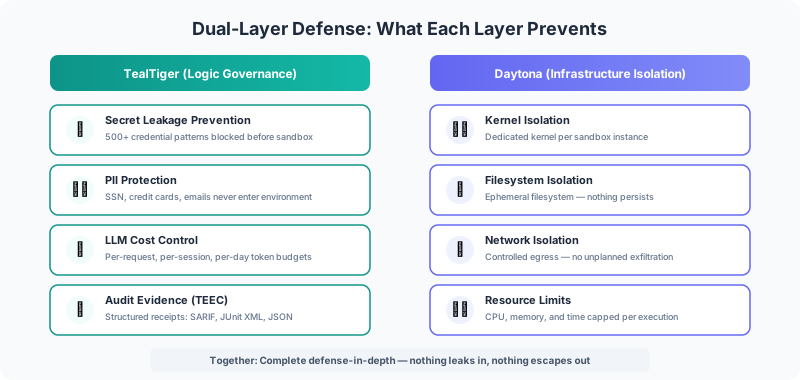
Neither layer alone covers the full threat surface:
- TealTiger without Daytona: you know the code is clean, but a zero-day in the runtime could still cause damage. No resource isolation.
- Daytona without TealTiger: code runs safely in isolation, but secrets and PII still enter the environment. No pre-execution audit trail.
Together, nothing leaks in and nothing escapes out.
Working example
The integration pattern is straightforward. TealTiger wraps the LLM client, Daytona wraps the execution environment. The governance decision happens at the boundary between them.
import os
from tealtiger import TealOpenAI
from daytona_sdk import Daytona

# TealTiger governs the LLM gateway
ai_client = TealOpenAI(
    api_key=os.getenv("OPENAI_API_KEY"),
    guardrails={
        "prompt_injection": True,
        "secret_detection": True,
        "pii_detection": True,
    },
    budget={"max_cost_per_session": 2.00},
)

# Daytona provides isolated execution
daytona = Daytona()

# Agent generates code — TealTiger scans the output
response = ai_client.chat.completions.create(
    model="gpt-4o",
    messages=[{
        "role": "user",
        "content": "Write a script to parse and transform user data"
    }],
)

# If we reach here, TealTiger approved the output
# Execute safely in Daytona's isolated sandbox
sandbox = daytona.create()
result = sandbox.process.code_run(
    response.choices[0].message.content
)

# Clean up
daytona.remove(sandbox)
If TealTiger detects a secret or PII in the LLM output, the response is
blocked before sandbox.process.code_run() is ever called. The sandbox is
never created, the code never runs, and the governance decision is logged
with a structured audit receipt.
Dual-layer cost control
One of the less obvious benefits: financial risk is eliminated from both directions.
| Layer | What it controls | How |
|---|---|---|
| TealTiger | LLM token spend | Per-request, per-session, and per-day budgets |
| Daytona | Compute resources | CPU, memory, and time caps per sandbox |
An infinite agent loop hits TealTiger’s budget limit before the LLM provider charges accumulate. Even if the loop somehow bypasses the token budget, Daytona’s resource limits cap the compute cost.
Unified audit trail
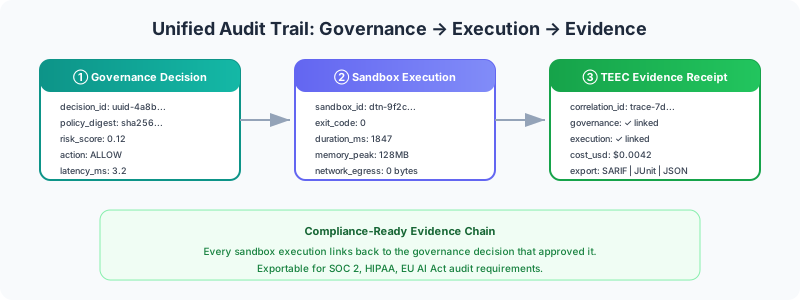
Every execution produces a TEEC (Typed Evidence & Evidence Contract) receipt that links:
- The governance decision — decision ID, policy digest, risk score, latency
- The sandbox execution — sandbox ID, exit code, duration, resource usage
- The correlation — OpenTelemetry-compatible trace ID linking both events
Receipts export as SARIF v2.1.0 (for security tooling), JUnit XML (for CI/CD), or JSON (for custom pipelines). Compliance teams get a single artifact proving that governance approved the execution before it happened.
Use case: secret interception
Here’s a concrete scenario. An agent is asked to “write a database connection script” and the LLM halluccinates a realistic-looking connection string:
# LLM generates this code:
import psycopg2

conn = psycopg2.connect(
    host="prod-db.internal.company.com",
    password="sk-prod-8f2a9b4c1d3e5f6a7b8c9d0e1f2a3b4c",  # ← TealTiger catches this
    database="users"
)
TealTiger’s TealSecrets module identifies the credential pattern, blocks the
response, and logs a governance decision with reason code
SECRET_DETECTED:generic_api_key. The sandbox is never created.
Without pre-execution scanning, that string would exist in:
- Daytona sandbox process memory
- Sandbox execution logs
- Potentially in network traffic if the connection attempt was made
Even in isolation, that’s a compliance violation — the secret entered a system it shouldn’t have.
Integration approaches
We see three paths for deeper integration:
1. Documentation and examples (available now)
A joint guide showing the TealTiger + Daytona pattern. Working code lives at
examples/daytona-governed-sandbox.
2. SDK wrapper (proposed)
A tealtiger-daytona package that wraps sandbox.process.code_run() with
automatic governance:
from tealtiger.integrations.daytona import GovernedSandbox

sandbox = GovernedSandbox(
    policy="default-deny",
    guardrails=["secret_detection", "pii_detection"],
)

# Governance happens transparently
result = sandbox.run(agent_generated_code)
3. Pre-execution hook (if Daytona supports it)
A native hook where TealTiger evaluates code before the sandbox executes it:
daytona.register_pre_execution_hook(tealtiger.evaluate)
This would make governance invisible to the agent framework — just a property of the execution environment.
Both already in the AG2 ecosystem
TealTiger and Daytona are both AG2 Beta Extensions. They coexist in the same
multi-agent framework at autogen/beta/extensions/. This means teams already
using AG2 for multi-agent workflows can layer both without introducing new
dependencies.
Getting started
Install both SDKs:
pip install tealtiger daytona-sdk
Set your environment:
export OPENAI_API_KEY="your-key"
export DAYTONA_API_KEY="your-key"
Run the governed sandbox example:
git clone https://github.com/agentguard-ai/tealtiger.git
cd tealtiger/examples/daytona-governed-sandbox
python governed_execution.py
Summary
| Concern | Without integration | With TealTiger + Daytona |
|---|---|---|
| Secrets in code | Enter sandbox, end up in logs | Blocked before sandbox creation |
| PII exposure | Contained but still present | Never enters the environment |
| Cost control | Either LLM or compute, not both | Both layers enforced |
| Audit evidence | Execution logs only | Governance decision + execution linked |
| Compliance proof | “It was isolated” | “It was evaluated AND isolated” |
Defense-in-depth means no single point of failure in your security story. TealTiger handles the logic. Daytona handles the infrastructure. Together, you get a governance posture that satisfies both the security team and the compliance auditors.
Resources:
Continue in the docs
Want the contract truth and implementation details? Go to the TealTiger documentation.