
TealTiger × Dakera: Governance State That Survives Restarts

How Dakera's persistent memory server gives TealTiger governance continuity across process restarts, agent migrations, and horizontal scaling.
TealTiger × Dakera: Governance State That Survives Restarts
TealTiger’s governance middleware evaluates policies in under 5ms — deterministic, no LLM in the path. But until now, governance state (cost records, decision receipts, delegation chains) lived in-memory. Process restarts, agent migrations, and horizontal scaling all lost that state.
For single-process prototyping, in-memory is fine. For production multi-agent systems running across multiple processes, you need governance continuity.
The Solution: Dakera as Governance State Backend
Dakera is a self-hosted AI agent memory server with agent-scoped state, decay-weighted retention, and a knowledge graph. It’s the first persistent backend for TealTiger’s governance layer.
pip install dakera[tealtiger]
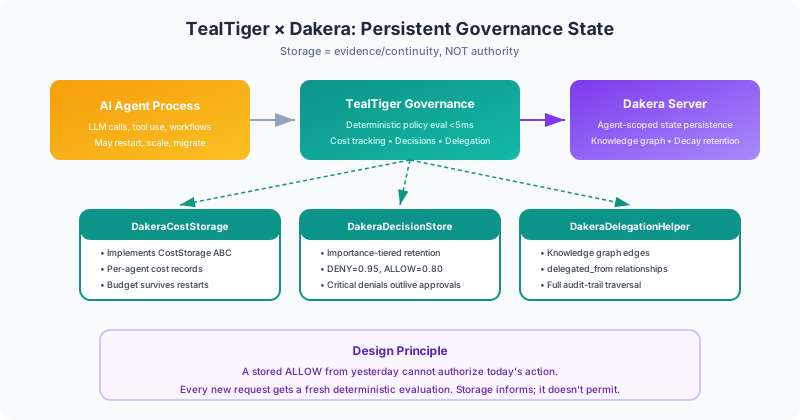
Three adapter classes shipped in dakera v0.12.1:
- DakeraCostStorage — implements all 8 methods of TealTiger’s
CostStorageABC. Per-agent cost records persist across restarts. - DakeraDecisionStore — governance decisions stored with importance-tiered retention (DENY=0.95, ALLOW=0.80). Critical denials outlive routine approvals.
- DakeraDelegationHelper — delegation chains stored as knowledge graph
edges (
delegated_from), enabling full audit-trail traversal.
Architecture Principle
A key design constraint (credit @rpelevin from the AG2 governance discussion):
Storage = evidence/continuity, NOT authority.
The storage layer answers:
- “Has this decision already reached a terminal state?” (idempotency)
- “What delegation chain was in force?” (evidence for new decision)
It does NOT answer: “Is this new action authorized?” — that always requires a fresh policy evaluation over the current action envelope.
This means a stored ALLOW from yesterday cannot authorize today’s action. Every new request gets a fresh deterministic evaluation. Storage informs; it doesn’t permit.
Usage
from dakera.async_client import AsyncDakeraClient
from dakera.integrations.tealtiger import DakeraCostStorage

from tealtiger import TealOpenAI, TealOpenAIConfig

client = AsyncDakeraClient("http://localhost:3000", api_key="dk-mykey")
cost_storage = DakeraCostStorage(client)

# Every LLM call's cost is now persisted in Dakera
teal_client = TealOpenAI(config=TealOpenAIConfig(cost_storage=cost_storage))
What This Enables
| Scenario | Before (in-memory) | After (Dakera) |
|---|---|---|
| Process restart | Cost budgets reset to zero | Budget state preserved |
| Agent migration | Decision history lost | Full receipt chain available |
| Horizontal scaling | Each instance has its own state | Shared governance state |
| Compliance audit | Manual log reconstruction | Query by agent, time, action type |
| Retry after timeout | Unknown if already executed | Idempotency check returns prior terminal state |
The Three Adapters
DakeraCostStorage
Implements TealTiger’s CostStorage abstract base class — all 8 methods.
Cost records are scoped per agent and persist across process boundaries.
from dakera.integrations.tealtiger import DakeraCostStorage

cost_storage = DakeraCostStorage(client)

# Budget enforcement continues across restarts
# If an agent spent $1.50 before a restart, it still knows that after restart
When an agent has a $2.00/session budget and the process crashes at $1.80
spent, the budget doesn’t magically reset. The next process picks up where
the last one left off.
DakeraDecisionStore
Governance decisions are stored with importance-weighted decay:
| Decision Type | Retention Weight | Rationale |
|---|---|---|
| DENY | 0.95 | Security-critical — must persist for compliance |
| ALLOW | 0.80 | Standard operations — retained but lower priority |
| MONITOR | 0.70 | Observational — useful for pattern detection |
This means critical security denials (secret detected, PII blocked, budget exceeded) persist longer than routine approvals. Dakera’s decay engine naturally ages out low-importance decisions while keeping compliance-critical evidence accessible.
DakeraDelegationHelper
Delegation chains are modeled as knowledge graph edges with
delegated_from relationships. When Agent A delegates authority to Agent B,
and Agent B delegates to Agent C, the full chain is traversable:
Agent A → delegated_from → Agent B → delegated_from → Agent C
This enables:
- Full audit-trail traversal for compliance review
- Answering “who authorized this action?” with a complete chain
- Revoking delegations by removing graph edges
Production Deployment Pattern
import asyncio
from dakera.async_client import AsyncDakeraClient
from dakera.integrations.tealtiger import (
    DakeraCostStorage,
    DakeraDecisionStore,
    DakeraDelegationHelper,
)
from tealtiger import TealOpenAI, TealOpenAIConfig

async def create_governed_client():
    """Create a TealTiger client with full Dakera persistence."""
    dakera = AsyncDakeraClient(
        "http://dakera.internal:3000",
        api_key="dk-production-key",
    )

    return TealOpenAI(
        config=TealOpenAIConfig(
            cost_storage=DakeraCostStorage(dakera),
            decision_store=DakeraDecisionStore(dakera),
            delegation_helper=DakeraDelegationHelper(dakera),
        )
    )

# Governance state now survives:
# - Process restarts (container recycling, deployments)
# - Horizontal scaling (multiple replicas share state)
# - Agent migrations (move agent to different node)
Links
- Dakera Integration Page
- Dakera Blog Post
- TealTiger Integration Docs
- Design Discussion: Dakera-AI/dakera-deploy#169
- PyPI:
pip install dakera[tealtiger]
Governance state shouldn’t be a single point of failure. With Dakera as the backend, TealTiger’s policy evaluation stays deterministic and fast, while the evidence it produces survives anything the infrastructure throws at it.
Continue in the docs
Want the contract truth and implementation details? Go to the TealTiger documentation.